
AI-Native Development and Agentic Orchestration Transforming Software with Autonomous AI

Software teams are no longer only asking AI to finish a line of code. They are asking it to read requirements, plan tasks, write tests, call tools, review logs, and suggest fixes. That shift marks the rise of AI-native development, where AI is built into the way software is designed, created, shipped, and improved.
This is not just a faster autocomplete story. It changes the shape of engineering work. Developers move from writing every instruction by hand to guiding systems that can reason, act, and learn from feedback. At the centre of this change is agentic orchestration, the practice of coordinating AI agents, tools, data, and rules so systems can make better decisions with less constant human input.

AI-native development changes how software gets built
Traditional software development treats AI as an add-on. A team writes an application, then connects a recommendation model, chatbot, or prediction engine later. AI-native development starts from a different place. The software is designed around AI capabilities from the beginning.
That means the application can interpret language, adapt to context, use external tools, and improve through feedback loops. The architecture often includes models, vector databases, retrieval systems, gateways, evaluation layers, and observability tools from day one.
A customer support platform is a simple example. A non-AI-native version may route tickets with fixed rules. An AI-native version can read the ticket, understand intent, search product documentation, check order status, draft a response, and escalate only when needed.
This approach is powering AI-native engineering by changing what developers spend time on. The focus shifts towards:
Designing clear goals and guardrails
Connecting models to trusted data
Testing AI behaviour, not only code paths
Monitoring accuracy, cost, latency, and safety
Building feedback loops from users and systems
The result can be faster delivery and more adaptive products. Yet it also raises hard questions. How do teams keep outputs reliable? How do they debug a system that makes probabilistic decisions? How do they stop an agent from taking the wrong action with confidence?
The benefits are real, but so are the risks
AI-native development brings practical gains when teams use it with discipline. It can reduce repetitive work, shorten research cycles, and help smaller teams build richer user experiences. Developers can ask an assistant to explain a legacy module, generate test cases, or create a first version of an API connector.
For users, AI-native products can feel more natural. Instead of clicking through menus, people can state a goal. A travel app can build an itinerary from preferences. A banking assistant can explain spending patterns. A healthcare admin tool can summarise non-sensitive operational notes for staff review.
Benefits
Faster prototyping, better personalisation, self-service workflows, richer automation, easier access to complex systems.
Challenges
Model errors, unclear accountability, data privacy risks, higher monitoring needs, unpredictable costs, security exposure through tool access.
The biggest challenge is trust. AI-native systems must handle uncertainty openly. Good products do not pretend every answer is final. They show sources where possible, ask for confirmation before high-impact actions, and keep humans involved when judgement matters.
Security also becomes more complex. If an AI agent can call APIs, write files, query databases, or trigger payments, it needs strict permissions. The system must treat the model as powerful but fallible.

Agentic orchestration gives AI systems a way to act
An AI agent is more than a chatbot. It can receive a goal, make a plan, use tools, observe results, and decide what to do next. Agentic orchestration is the layer that manages this process.
A well-orchestrated system answers questions such as:
Which agent should handle this task?
Which tool can the agent use?
What data is allowed?
When should the system ask a human?
How should errors be retried or contained?
How should the final answer be checked?
Think of a software maintenance agent. A user reports that an app page is slow. The orchestrator may assign one agent to inspect logs, another to analyse recent deployments, and another to suggest a code change. A review agent may then check the patch before a developer approves it.
This is where concepts such as Intent-Driven Architecture, Hierarchical Orchestration, and Universal Tool-Use become useful. The system starts with the user’s intent, breaks it into smaller tasks under a hierarchy of agents, and gives those agents controlled access to tools such as search, databases, ticketing systems, code repositories, or deployment platforms.
The goal is not full independence at any cost. The goal is useful autonomy with checks at the right points.
Real-world examples are already taking shape
AI-native development is visible across many domains, even when the labels differ.
In software engineering, coding assistants can generate functions, explain errors, write unit tests, and review pull requests. More advanced setups connect these assistants to issue trackers, documentation, and build systems. The developer becomes the reviewer and guide rather than the only author.
In e-commerce, AI-native shopping assistants can interpret vague requests such as “I need a formal outfit for a winter wedding in Jaipur” and narrow choices based on size, budget, weather, and style preferences. The orchestration layer may combine search, inventory, recommendations, and return policy checks.
In operations, incident response agents can watch alerts, group related issues, query logs, summarise likely causes, and draft a remediation plan. A human engineer still approves major changes, but the investigation starts faster.
In education, AI-native tutors can adjust explanations based on a learner’s answers. The system can generate practice questions, detect weak areas, and recommend revision paths. Guardrails matter here because the tutor must avoid confidently teaching incorrect material.
Good orchestration needs rules, memory, and evaluation
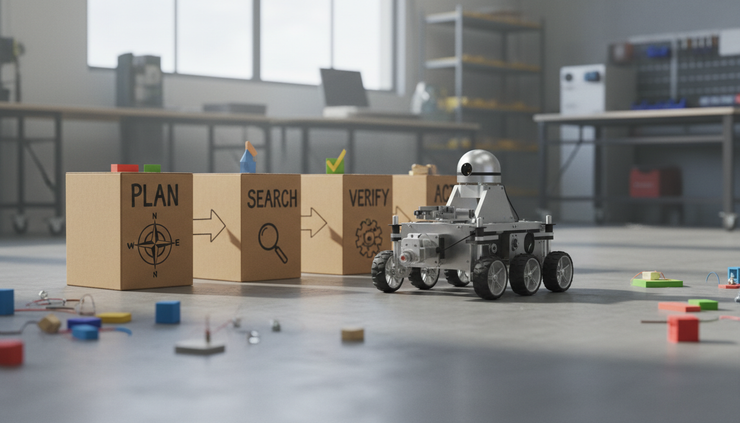
Agentic orchestration works best when teams design it as a controlled system, not a loose chain of prompts. The orchestration layer should define roles, permissions, memory, fallback paths, and evaluation methods.
A practical strategy often includes:
Role-based agents
Each agent has a narrow job, such as researcher, planner, coder, tester, or reviewer. Narrow roles reduce confusion and make failures easier to trace.
Tool limits
Agents only get access to tools they need. A documentation agent does not need payment access. A code review agent may read repositories but not deploy changes.
Human checkpoints
The system pauses before sensitive actions. This includes deleting data, sending customer messages, changing production systems, or making financial decisions.
Continuous evaluation
Teams test not only whether the software runs, but whether the AI behaves well. They review outputs for accuracy, bias, safety, cost, and latency.
Shared memory with boundaries
Agents may need context from past steps, but memory should be scoped. Sensitive data should not spread across the system without clear need.
These patterns make autonomy safer. They also make AI systems easier to improve over time.

The next phase of software is guided autonomy
AI-native development is changing software from static workflows into adaptive systems that can understand goals and act on them. Agentic orchestration gives those systems structure, so autonomy does not become chaos.
The winners will not be the teams that add AI everywhere. They will be the teams that decide where AI should act, where it should ask, and where it should stay silent. Build with clear intent, strong guardrails, and honest evaluation, and autonomous AI becomes more than a demo. It becomes a dependable part of modern software creation.


Comments